El shock circulatorio es una emergencia médica que requiere
un manejo rápido y eficiente, y cuyo tratamiento varía en función de la
etiología y fisiopatología del proceso que lo ha desencadenado. Pese a ello,
sería útil tener un procedimiento universal, fácil de recordar y con objetivos
claros, para aplicar a todos los pacientes que lo sufren, con independencia de
su origen. Un grupo de médicos de diferentes países (Egipto, Italia, Austria,
Reino Unido, Francia e India) han publicado un artículo en el que proponen un
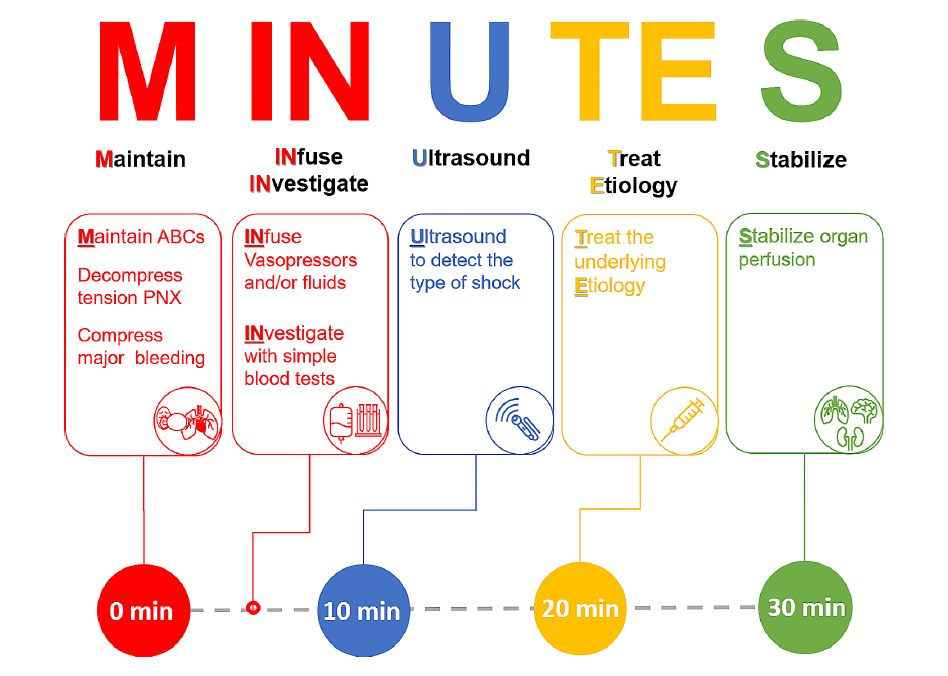
algoritmo único de tratamiento para los primeros 30 minutos. Lo resumen en el
acrónimo MINUTES, que engloba una serie de medidas, con sus correspondientes
intervalos de aplicación, para el manejo inicial de cualquier paciente en
shock. Enlace de descarga: https://drive.google.com/file/d/1I-J8ead-JKzV6i1yU2hA25LM0Jk30Toq/view?usp=sharing
Acute
circulatory shock is a life-threatening emergency that requires an efficient and
timely management, and a differentiated treatment according to shock etiology
and pathophysiology. Nevertheless, a simple, easily memorable bundle of interventions
could facilitate standardized treatment. A group of doctors from different
countries (Egypt, Italy, Austria, United Kingdom, France and India) has developed
and published their proposal for a universal management of shocked patients.
They call it the MINUTES bundle, it’s suitable for every patient in shock, and
includes seven sequential steps with a specific timeline to be implemented: 30 minutes .
Download link: https://drive.google.com/file/d/1I-J8ead-JKzV6i1yU2hA25LM0Jk30Toq/view?usp=sharing
Aunque la actualización 2024 de las recomendaciones ILCOR,
recientemente publicada, no ha modificado el papel de la vía intraósea como
alternativa aceptable a la vía intravenosa para la administración de fármacos durante la realización del Soporte Vital Avanzado, este año se han publicado algunos estudios
relevantes sobre este tema. Presentamos, en este post, acaso los más
importantes. El primero es un estudio retrospectivo estadounidense, con un
universo de 155.884 pacientes, que evalúa su uso, en términos de supervivencia
al alta, en la extremidad inferior y superior, y concluye que su uso humeral se
asocia con mayor supervivencia al alta. Puedes descargarlo aquí: https://drive.google.com/file/d/1JRDq3IjlWhmpDAlg6Y4mVZyelWhxqiRT/view?usp=sharing
El segundo, taiwanés, es un ensayo aleatorizado controlado sobre 1.771 pacientes
que compara los resultados de un grupo al que se le coloca una vía intravenosa
en los miembros superiores y otro que recibe una punción intraósea en el
húmero. El estudio no encuentra diferencias de supervivencia al alta, e invita
a considerar la vía intraósea como un acceso vascular de primera elección en
este tipo de pacientes. Enlace de descarga: https://drive.google.com/file/d/1NMrCuzfSevLwnJq7mQmdb4K2CJ9OJj-I/view?usp=sharing
El tercero, danés, es otro ensayo aleatorizado controlado publicado hace solo 20 días. Este, con un universo de 1.479, y dos grupos: uno que recibió un acceso intravenoso y otro que recibió un acceso intraóseo. En este último grupo se randomizó, con una ratio 1:1, el acceso intraóseo tibial y humeral. Su conclusión es similar a la del estudio taiwanés: no se observa diferencia significativa, en términos de recuperación de la circulación espontánea, entre los dos tipos de acceso vascular. Enlace de descarga: https:/drive.google.com/file/d/1LjC70hFcggIjVax4Ivh-OeRPwt-Kw2zl/view?usp=sharing
Sigue habiendo dudas sobre el tiempo necesario para conseguir un acceso
intraóseo en la extremidad superior y su repercusión sobre la calidad de la
RCP, pero el debate sobre el lugar del acceso intraóseo en la asistencia a los
pacientes en parada cardiacasigue de plena actualidad.
Although
2024 ILCOR update on CPR and EEC, recently issued, hasn’t modified the role of
intraosseus (IO) access as an acceptable alternative to intravenous (IV) access during Advanced
Life Support procedures, this year a few relevant articles on this topic have
been published. We bring here perhaps the most important of them. The first one, an
American retrospective study (with a universe of 155.884 patients) on its use
in upper and lower extremity during CPR, concludes that its use in upper
extremity was associated with both improved survival to discharge and survival
to discharge to home. Download link: https://drive.google.com/file/d/1JRDq3IjlWhmpDAlg6Y4mVZyelWhxqiRT/view?usp=sharing
The second one, a cluster randomized controlled trial from Taiwan with 1.771
patients, compared the results between an intravenous group of patients, who
received IV puncture in the upper extremities, and an intraosseus group, who
received a punction in the humeral bone. The study found no difference
regarding to hospital discharge between the groups, and invites to consider
intraosseus access a first line choice of vascular access rather than a
secondary to IV access one. Download link: https://drive.google.com/file/d/1NMrCuzfSevLwnJq7mQmdb4K2CJ9OJj-I/view?usp=sharing
The third one is another randomized controlled trial, Danish and with 1.479 patients, published 20 days ago. It compared the results between an IV group and an IO group; there were a relation 1:1 between humeral and tibial insertion in the latter. Its conclusion is similar to the Taiwanese trial: no significant difference in sustained ROSC between IV an IO access was found. Download link: https://drive.google.com/file/d/1LjC70hFcggIjVax4Ivh-OeRPwt-Kw2zl/view?usp=sharing
There are still concerns about the time necessary to get an intraosseus access
and its repercussion on the quality of the CPR, but these studios continue
paving the way to consider IO access, at least in upper extremity, as a first
line vascular access in these patients.
Las guías previas a la publicación de este documento de
consenso recomendaban el uso de fármacos inotrópicos en situaciones de
insuficiencia cardiaca aguda descompensada con evidencia de hipoperfusión
orgánica. Sin embargo, puede ser razonable utilizarlos también en otros pacientes
con insuficiencia cardiaca crónica que no presentan una descompensación aguda
severa: especialmente, en pacientes con congestión cardiaca persistente, con
hipoperfusión sistémica, con cuadros muy avanzados que precisan medidas paliativas,
y también en situaciones concretas relacionadas con la implantación de un
dispositivo de asistencia ventricular o el trasplante cardiaco. De su uso en
estos pacientes, y también de cómo mantenerlos y retirarlos en situaciones
paliativas o terminales, trata este documento de consenso, elaborado por
encargo de la Sociedad Europea de Cardiología por 23 cardiólogos de diversos
países europeos, Turquía, Israel, EEUU y Australia. Enlace de descarga: https://drive.google.com/file/d/19SibP9fVGMujqzh_pYyi414d2Bjv3cwy/view?usp=sharing
The
guidelines in force before the publication of this consensus statement
supported the use of inotropes in the setting of acute decompensated heart
failure with evidence of organ malperfusion. However, inotropic support may be
reasonable in other patients with advanced heart failure without acute severe
decompensation. Particularly, patients with persistent congestion, systemic
hypoperfusion, advanced heart failure with need for palliation, and in specific
situations relevant to implantation of left ventricular assist devices or heart
transplantation. Guidance for its use in these patients, and on its maintenance
and weaning in situations of palliative and end-of-life care, is what this
consensus, developed by 23 cardiologists from different countries on behalf of
the European Society of Cardiology, is about. Download link: https://drive.google.com/file/d/19SibP9fVGMujqzh_pYyi414d2Bjv3cwy/view?usp=sharing
El manejo de la sedoanalgesia en los pacientes adultos sometidos
a ventilación no invasiva ha de ser cuidadoso, pues un uso inadecuado de la
misma puede llegar a inducir el propio fracaso del tratamiento. El documento de
consenso de expertos elaborado, siguiendo el método Delphi, por la Società
Italiana di Anestesia, Analgesia, Rianimazione e Terapia Intensiva (SIAARTI), revisa
todos los aspectos relacionados con la cuestión. El punto que quizá pueda
resultar más interesante en un principio, qué fármacos utilizar y cuáles
evitar, se revisa en la pregunta 2. Enlace de descarga: https://drive.google.com/file/d/1M71dwmzCc_c4T-CNyt8aD8o_RLa9qmJK/view?usp=sharing
The use of
an analgosedation strategy in adult patients treated with noninvasive
respiratory support should be considered only after careful assessment, in order
to avoid a NRS failure secondary to it. The expert Delphi consensus document
issued by the Italian Society of Anesthesia, Analgesia, Resuscitation and
Intensive Care (SIAARTI) reviews different aspects related to the use of
analgosedation in these patients. Maybe the most interesting issue, that
related to the drugs that should be used and the ones that should be avoided, is
reviewed in the question 2. Download link: https://drive.google.com/file/d/1M71dwmzCc_c4T-CNyt8aD8o_RLa9qmJK/view?usp=sharing
La hipertensión es el trastorno médico más común durante el
embarazo; afecta al 5-10% de los embarazos, y su prevalencia es creciente. Es,
además, la primera causa de mortalidad materna en los países industrializados. Dos
cardiólogos del departamento de Medicina de la Universidad de Columbia (EEUU) publicaron
en 2021 una completa revisión narrativa que repasa todos los aspectos relacionados
con el diagnóstico, la clasificación y el tratamiento de los trastornos
hipertensivos en el embarazo, incluido el llamado cuarto trimestre (las 12
primeras semanas tras el parto), un periodo en el que se producen más de la
mitad de las muertes maternas relacionadas con el embarazo. Puedes descargarlo aquí: https://drive.google.com/file/d/1dtI00MzwbP58T8Thmt0eEHRfZDcPbv9m/view?usp=sharing
Hypertension
is the most common medical disorder occurring during pregnancy, complicating 5%
to 10% of all pregnancies. It is also the leading cause of maternal mortality
in industrialized countries, and its prevalence is increasing. Two
cardiologists from the Medicine Department of the Columbia University (2021)
published in 2021 a narrative review that comprises questions related to the
diagnosis, the classification and the treatment of the hypertensive disorders of
pregnancy. It includes only the so-called
fourth trimester, the 12 weeks after delivery. A period in which occur more
than one-half of pregnancy-related maternal deaths. Download link: https://drive.google.com/file/d/1dtI00MzwbP58T8Thmt0eEHRfZDcPbv9m/view?usp=sharing
Las guías ILCOR recomiendan, ante la falta de evidencia
concluyente para decidirse por una, varias posibles maniobras para remediar una OVACE (obstrucción de
vía aérea por cuerpo extraño): golpes interescapulares, compresiones
abdominales (maniobra de Heimlich) y, en pacientes inconscientes y grupos
concretos de pacientes conscientes (obesos, embarazadas), compresiones
torácicas.
La evidencia de calidad sobre cuál de las maniobras es más
efectiva es prácticamente inexistente. El estudio que traemos hoy, elaborado por
un grupo de médicos de la provincia canadiense de Alberta y con un tamaño
muestral de 709 pacientes con OVACE, concluye que los golpes interescapulares
parecen ser más efectivos que las compresiones abdominales y que producen menos
lesiones secundarias. También demuestra que cuando las maniobras son realizadas
precozmente, por testigos, la tasa de mortalidad es menor que cuando el primer
interviniente es un sanitario movilizado por el servicio de emergencias médicas. El estudio presenta algunas limitaciones
importantes, pero aun así sus conclusiones son muy interesantes. Enlace de
descarga: https://drive.google.com/file/d/1QzepTCdldB9kMkh91NanpvI6Su1xP_2U/view?usp=sharing
ILCOR
guidelines recommend, due to the lack of conclusive evidence to make one of
them mandatory, a few different manoeuvres to relieve the FBAO (foreign body
airway obstruction): back blows, abdominal thrusts and, in unconscious patients
and some specific groups of conscious patients (e.g., with obesity or pregnancy),
chest compressions/thrusts.
Quality
evidence on the compared effectiveness of those manouevres is almost
non-existant. The study we bring to the blog today, from a group of doctors from
Alberta (Canada) and with a universe of 709 patients with FBAO requiring
intervencion, concludes that back blows seem to be more effective than abdominal
thrusts, and that there are much less intervention-associated injuries. It also
states that initial bystander intervention reduces the mortality rate when
compared to initial paramedic intervention. There are some relevant limitations
in the study, identified by its authors, but nevertheless its conclusions are pretty
interesting. Download link: https://drive.google.com/file/d/1QzepTCdldB9kMkh91NanpvI6Su1xP_2U/view?usp=sharing
Cuando se realiza manejo avanzado de la vía aérea durante
una RCP debe aplicarse, según las recomendaciones de las sociedades
internacionales, presión ventilatoria positiva de forma continua y sin interrumpir
las compresiones torácicas. Una forma de hacerlo, especialmente en entornos con
poco personal entrenado para realizarlo correctamente mediante el uso de una
bolsa-mascarilla, es conectar al paciente a un ventilador mecánico. No existen
recomendaciones específicas sobre cómo hacerlo, sin embargo, y los autores de
esta carta al director publicada en el Indian Journal of Critical Care
Medicine, un grupo de urgenciólogos de India, proponen, tomando como base la evidencia
publicada, utilizar una ventilación controlada por volumen con unos ajustes
concretos de los diferentes parámetros que podemos variar en este modo
ventilatorio. Enlace de descarga: https://drive.google.com/file/d/1JDA0esI-MNbfuP-vmP6KZanYjXa3m0V0/view?usp=sharing
Whenever an
advanced airway is in place during cardiopulmonary resuscitation, positive
pressure ventilation should be provided without pausing for chest compression. It
can be accomplished through bag-valve resuscitator (BV) or mechanical
ventilator (MV), which was found to be equally efficacious. In a busy emergency
department, with less trained personnel use of MV is advantageous over BV in
terms of reducing human errors and relieving the airway manager to focus on
other resuscitation tasks. Currently, there are no guidelines specific to MV
settings in cardiac arrest. The authors of this letter to the editor published
in the Indian Journal of Critical Care Medicine, a bunch of emergency medicine
doctors from India, present a concept of “six-dial ventilator strategy during
CPR” that encompasses the evidence-based settings appropriate during chest
compression. Download link: https://drive.google.com/file/d/1JDA0esI-MNbfuP-vmP6KZanYjXa3m0V0/view?usp=sharing
El reciente documento de posición común de las sociedades
médicas estadounidenses relacionadas con la asistencia al trauma (ACS, ACEP y NAEMSP)
sobre el control y el manejo de las hemorragias en el entorno prehospitalario
incluye una referencia a los torniquetes de unión (junctional tourniquet),
considerándolos una alternativa válida para detener la hemorragia en algunas
zonas en las que no es posible colocar un torniquete convencional, la axila y
la ingle, aunque reconociendo que no hay aún evidencia suficiente para
justificar su uso rutinario en el ámbito civil.
En este post hemos reunido información sobre estos
dispositivos, de uso y conocimiento limitado en nuestro medio. El primer
documento que incluimos es una revisión StatPearls, actualizada en noviembre de
2023, sobre el manejo extrahospitalario de la hemorragia en la unión de las
extremidades con el torso https://bit.ly/3Lz9WxG
. En él se mencionan cuatro tipos de dispositivos diferentes, los aprobados por
la FDA estadounidense, que, tras ser evaluados en adultos sanos en una revisión
sistemática publicada en 2019, https://bit.ly/3Yf8CHP
, demostraron ser eficaces a la hora de alcanzar la oclusión vascular. Su uso
en el entorno militar, como parte del Tactical Combat Casualty Care, podría
articularse a través del algoritmo propuesto en este artículo de 2020. https://bit.ly/4cX0mkf
Pasando a los dispositivos en sí, incluimos aquí un folleto
de entrenamiento sobre el manejo del SJT, el SAM Junctional Tourniquet, que se
basa en la superposición, sobre un cinturón pélvico SAM modificado, de un dispositivo
de compresión que se infla con una pera. https://bit.ly/4cMwEhM
. El pdf incluye, además de la descripción del dispositivo y la forma de
utilizarlo para coartar los diferentes tipos de hemorragia, un enlace a este
vídeo:
El AAJT-S (Abdominal Aortic Junctional Tourniquet-Stabilized)
es un cinturón que se fija en el abdomen, la axila o la ingle, en el que se
logra la compresión aórtica o de las arterias iliaca o axilar mediante el
inflado de una vejiga neumática. https://bit.ly/3LAqllv
. Como una imagen vale más que mil palabras, aquí la tienes:
El Combat Ready Clamp (CRoC) es un dispositivo diferente. En
lugar de utilizar un dispositivo inflable usa un dispositivo para “atornillar”
un disco de compresión sobre el punto exacto a comprimir, creando según el
fabricante una presión bidireccional en el lugar que detiene el flujo
colateral. Adjuntamos instrucciones de uso en texto https://bit.ly/3SlA1Edy vídeo:
El JETT (Junctional Emergency Treatment Tool), por último,
es un cinturón que incluye dos dispositivos de presión mecánica que permiten la
oclusión simultánea de ambos miembros inferiores. Puedes verlo con más detalle
en este folleto, https://bit.ly/3A3P5jp , y
descubrir cómo se coloca en este vídeo:
The recent joint position statement of the US medical societies related to trauma patients (ACS, ACEP and NAEMSP) on prehospital hemorrhage management and treatment includes the use of junctional tourniquets to apply pressure in regions (shoulder/axilla and groin) that are too proximal for extremity tourniquet application. Nevertheless, the document also points that there is still inadequate clinical experience and data in civilian trauma to routinely recommend them.
As these are devices with very limited knowledge among civilian EMS providers (at least in Spain) we have gathered some information to give our readers a perspective on them. First of all, a StatPearls review, updated on November 2023, on EMS junctional hemorrhage control: https://bit.ly/3Lz9WxG . The article describes the four different devices that, evaluated on healthy volunteers in a systematic review published in 2019, https://bit.ly/3Yf8CHP , proved to be effective to achieve vascular occlusion. Its use in the combat environment is less controversial than in the civilian one, and this article, published in 2020, proposes an algorhytm for an implantation of junctional tourniquets as par of tactical combat casualty care. https://bit.ly/4cX0mkf
One of these devices is the SJT (SAM Junctional Tourniquet), that consists on a modified SAM pelvic sling in which we put a target compression device, inflatable with a removable hand pump. You can download here, https://bit.ly/4cMwEhM , a document that shows what the SJT is and how it works, and that includes a link to this video:
A similar device, belt-base, is the AAJT-S (Abdominal Aortic Junctional Tourniquet-Stabilized), a belt that uses a windlass to tighten and stabilize its position on the abdomen, groin or axilla. Once in place, a pneumatic bladder is inflated to occlude the aorta, iliac artery, or axillary artery. https://bit.ly/3LAqllv . This video shows you how to use it:
The CRoC®Combat uses a different approach. It’s not inflatable; it has a vice-like compression disk that creates, according to the spefications sheet of the product, https://bit.ly/3SlA1Ed , bi-directional pressure exactly where it is needed, stopping collateral flow and controlling hemorrhage.
Finally, The Junctional Emergency Treatment Tool™ (JETT®) is a belt that includes two pressure devices in a single tool, allowing for simultaneous occlusion of blood flow to both lower limbs (bilateral) with an easy to apply, pre-assembled, ready-to-use belt solution. You can take a look at it in this brochure, https://bit.ly/3A3P5jp, and learn how to apply it in this video:
La exanguinación sigue siendo la principal causa de muerte
evitable en las víctimas de traumatismos, y casi la mitad de los pacientes que
mueren por esta causa lo hacen en el medio extrahospitalario. El Comité de
Trauma del Colegio Americano de Cirujanos, la Asociación Americana de Médicos
de Urgencias y la Asociación Nacional de Médicos de SEM han elaborado
recientemente un documento conjunto de consenso, basado tanto en la evidencia
más reciente disponible como en la opinión de los expertos (autores y organizaciones
firmantes), sobre el control del sangrado y la reanimación hemostática
extrahospitalaria de los pacientes traumatizados con un sangrado importante que
represente un riesgo para su vida. Puedes descargar el documento, que incluye
ocho puntos de consenso, en el siguiente enlace: https://drive.google.com/file/d/1is5keT7MbRtLxFQk4FEhP298uxPwrYu5/view?usp=sharing
Exanguination
remains the leading cause of preventable death among victims of trauma with
nearly half of these patients dying in the prehospital setting. The American
College of Surgeons Committee on Trauma, the American College of Emergency
Physicians and the National Association of EMS Physicians have issued recently
a joint consensus opinion on prehospital hemorrhage control and hemostatic
resuscitation. The statement, based on the current published evidence and the
collective expertise of the autors and represented organizations, is intended
for use by EMS personnel, emergency physicians, trauma surgeons and nurses when
treating acute trauma patients with severe, life-threatening external bleeding.
It proposes eight points of consensus, and can be downloaded here: https://drive.google.com/file/d/1is5keT7MbRtLxFQk4FEhP298uxPwrYu5/view?usp=sharing
Este artículo, que ha obtenido el 18ª premio Pepe Milla, que reconoce al mejor trabajo científico desarrollado por urgenciólogos españoles en el año 2023, en el 34ª Congreso de la Sociedad Española de Medicina de Urgencias y Emergencias, recoge los resultados de un estudio observacional prospectivo sobre 200 pacientes que busca evaluar la eficacia y la seguridad de la oxigenoterapia de alto flujo en pacientes mayores de 75 años con insuficiencia respiratoria aguda no secundaria a COVID-19, refractaria al tratamiento con oxigenoterapia convencional y/o intolerancia a la ventilación no invasiva o la CPAP y sin criterios de ingreso en una unidad de cuidados intensivos. Enlace de descarga: https://drive.google.com/file/d/1cdz0Kv-EnTkfKocR4QlCL8AFr1zxovL2/view?usp=sharing
This article, which was awarded with the 18th Pepe Milla prize, that rewards the best scientific article published by Spanish emergency medicine doctors during 2023, shows the results of an prospective observational study with 200 patients aimed at assessing the efficacy and safety of high-flow nasal cannula (HFNC) in elderly patients with acute respiratory failure (ARF) not due to COVID-19, refractory to treatment with conventional oxygen therapy and/or intolerant to noninvasive ventilation (NIV) or continuous positive airway pressure (CPAP) and without criteria for admission to intensive care units (ICU). Download link: https://drive.google.com/file/d/1cdz0Kv-EnTkfKocR4QlCL8AFr1zxovL2/view?usp=sharing
Desde que en 1919 Weed y McKibben demostraron, en gatos, la
utilidad de las soluciones hipertónicas para la reducción del edema cerebral,
el uso de estas se ha ido extendiendo, y hay diversas guías clínicas que
consideran su uso con preferencia respecto al manitol en determinados cuadros
clínicos. Sin embargo, la evidencia sobre la superioridad de uno u otro
tratamiento para lograr una mejoría a largo plazo no es ni mucho menos
concluyente, y no existe ninguna formulación estándar ni acuerdo sobre la forma
de administración, la concentración ideal, la tasa de infusión o el
almacenamiento seguro del suero salino hipertónico. El artículo que traemos
hoy, firmado por un grupo de farmacéuticos estadounidenses, revisa la evidencia
disponible sobre estos aspectos prácticos relacionados con el uso del suero
salino hipertónico. Enlace de descarga: https://drive.google.com/file/d/1sGFpPXOMJss9XbFs0xZLAW7t_ihLs-4F/view?usp=sharing
The utility
of hypertonic solutions for decreasing cerebral edema was first reported in
1919 by Weed and McKibben, who performed experiments on cats that showed its
capabilities. Its clinical applications has increased since then, and current
Neurocritical Care Society guidelines recommend hypertonic saline over mannitol
in some scenarios. Nevertheless, a conclusion on the superiority of one or
other treatment for long-term outcomes has not been established yet.
Furthermore, practical questions remain regarding the appropriate
administration method, concentration, infusion rate, and storage. The article
we bring today, signed by a group of American pharmacologists, aims to address
these practical concerns based on the evidence currently available. Download
link: https://drive.google.com/file/d/1sGFpPXOMJss9XbFs0xZLAW7t_ihLs-4F/view?usp=sharing
En las últimas décadas se ha producido un cambio de
paradigma respecto a la parada cardiaca traumática (PCT); su reanimación, considerada
antes un intento fútil, ofrece ahora mejores perspectivas, al menos en
subgrupos seleccionados de pacientes. Hay varios factores que han influido en
ello: una mejor comprensión de la fisiopatología de la PCT, que ha permitido
una división del concepto en otros más concretos, su diferenciación clara del
resto de causas de la PC, la publicación de guías más específicamente enfocadas
a ella, avances diagnósticos y terapéuticos y una mejoría en la formación del
personal que las asiste. El artículo que traemos hoy al blog, firmado por cuatro
médicos hospitalarios y extrahospitalarios de Ámsterdam (Países Bajos), revisa
el estado actual del conocimiento sobre el manejo de esta entidad clínica.
Enlace de descarga: https://drive.google.com/file/d/1QqeXFHh0TPLTkwy1Fw41Jm-20bncr8FF/view?usp=sharing
In the
treatment of traumatic cardiac arrest (TCA) a paradigm shift occurred in recent
decades, switching resuscitation in TCA from a merely futile attempt to a more
promising intervention, at least in selected subgroups. Several reasons account
for this, ranging from a better understanding of the pathophysiology of TCA,
division into distinct TCA entities, separation from other causes of CA,
refined guidelines, technical advances in both diagnostics and therapy, and
also improved training on this formerly potentially neglected topic. The
article we bring today, written by four in- and out-of-hospital doctors from
Amsterdam (The Netherlands) summarize the current understanding of TCA key
points. Download link: https://drive.google.com/file/d/1QqeXFHh0TPLTkwy1Fw41Jm-20bncr8FF/view?usp=sharing



.png)


.png)


